
Best Free AI Websites

ai

How to Turn One Product Photo Into a $7,530 Client Proposal With Lovart 2.0

How to Turn One Product Photo Into a $7,530 Client Proposal With Lovart 2.0

What if a single product photo could become an entire marketing campaign, and seven different services you could sell to a business?

Not seven AI-generated pictures. Seven actual creative services that businesses already need, from product photography and social media content to advertising, promotional videos, and website banners.

And what if you could manage much of the creative production with one AI design agent?

That’s the business opportunity I want to explore with Lovart 2.0 and Arti, its new personal AI design agent.

I’m going to walk you through a hypothetical $7,530 marketing proposal, showing how you could transform one product photo into a complete creative package.

The numbers are illustrative service prices, not guaranteed income or verified market averages. What matters is the business model behind them.

Watch the video walkthrough of Lovart 2.0 and Arti. Open on Instagram

Meet Lovart 2.0: An AI Design Agent That Goes Beyond Generating Images

Most AI image generators work in a familiar way.

You enter a prompt, generate an image, download it, and start over when you need something else.

That can be useful, but running a creative business requires far more than producing individual images.

You need to understand the client’s brand, research creative directions, maintain consistency, produce content across different formats, handle revisions, and repeat that process for every new campaign.

Lovart 2.0 approaches the problem differently.

It’s an AI-powered design workspace where you can plan, generate, and edit creative assets, including images and videos.

The biggest addition in Lovart 2.0 is Arti, a personal design agent designed to learn how you work and help manage more of the creative process.

Arti introduces several useful capabilities:

  • Persistent memoryIt remembers your aesthetic preferences, collaboration style, and frequently used assets across projects, with controls to review and edit that memory.
  • Design delegationAssign complete creative tasks that run once or on a daily, weekly, or monthly schedule.
  • Design ResearchGather visual references, creative inspiration, and design insights, including sourced research and mood boards.
  • Design ReviewIdentify inconsistencies between your work and the project’s creative requirements.
  • Feedback revisionCollect comments on specific design elements and turn them into structured revision plans.
  • Self-evolving skillsRepeated workflows can become reusable skills, helping you work more consistently over time.

The interesting shift here isn’t simply generating designs faster.

It’s moving from using AI as a design tool to using AI as part of a repeatable creative production workflow.

And that’s where the business opportunity begins.

7 AI-Powered Services You Could Offer With Lovart 2.0

Imagine a skincare brand approaches you.

They have a good product, an online store, and some basic photos. But they need more professional marketing materials to attract customers.

Instead of offering them one graphic or one social media post, you could build an entire creative proposal around their product.

Here’s an example of what that proposal might look like.

Seven AI-powered creative services created from one Powerball 280Hz Classic product photo, with a total client proposal of $7,530
Creative service Example project price
30 days of social media content $870
Professional e-commerce product images $590
8 advertising creatives $1,200
3 promotional videos $1,650
Email marketing designs $980
Website banners and graphics $1,250
Campaign localization $990
Total potential client proposal $7,530

Let’s break down each service and how Lovart 2.0 could fit into the workflow.

1. Create an Entire Month of Social Media Content ($870)

Businesses need consistent content for Instagram, Facebook, TikTok, and other platforms.

The challenge isn’t necessarily coming up with one good post. It’s maintaining quality and consistency throughout the month.

With Lovart 2.0, you could use a client’s product photo, brand assets, and marketing brief to develop a coordinated collection of social media creatives.

For example, you might create promotional posts, product highlights, educational carousels, seasonal announcements, and campaign graphics.

Arti’s design delegation feature makes this particularly interesting.

You can assign recurring research or creative tasks, choose a schedule, set a credit limit, and test the results before enabling the delegation.

Imagine preparing weekly creative recommendations for a brand without having to rebuild the entire workflow every Monday.

Example service value: $870

2. Create Professional E-commerce Product Visuals ($590)

One of the most practical uses of AI design tools is creating additional marketing visuals from an existing product image.

A small online store might have only basic photographs of its products.

But for its website and marketing campaigns, it may need lifestyle compositions, promotional backgrounds, different product arrangements, and marketplace-ready visuals.

Lovart’s creative workspace can help develop those assets while keeping them organized within the same project.

For example, you could take a basic product photo and create different visual directions for a luxury campaign, a seasonal promotion, or an e-commerce collection.

The key is preserving accurate product details. AI-generated imagery should be reviewed carefully for packaging errors, inaccurate colors, or features that don’t exist.

Example service value: $590

3. Design 8 Advertising Creatives ($1,200)

Running successful Meta advertising campaigns often means testing multiple creative concepts.

Businesses may need different visuals for different audiences, promotions, and placements.

Instead of producing just one advertisement, you could offer a package of eight creative variations.

That might include product-focused designs, promotional offers, testimonial-style layouts, lifestyle concepts, and multiple headlines or calls to action.

Lovart’s canvas provides a workspace for building and editing these variations.

Arti’s Design Research can help explore creative directions, while Design Review can flag inconsistencies before the campaign is delivered.

This doesn’t guarantee better advertising performance. The creatives still need testing, and the advertiser needs a sound strategy.

But it can make developing a broader range of creative concepts more manageable.

Example service value: $1,200

4. Produce 3 Promotional Videos ($1,650)

Video is another service you can add to the same client proposal.

Imagine taking the product’s existing visual assets and developing three short promotional videos for social media advertising or organic content.

One video might introduce the product. Another could communicate its benefits. A third might focus on a special offer.

Lovart brings image and video generation capabilities together in its creative workspace, including access to multiple supported AI models.

This gives you options for developing visual concepts, experimenting with motion, and creating video assets without switching between as many separate tools.

The final videos still need creative direction, editing, quality control, and appropriate usage rights.

Example service value: $1,650

5. Build Email Marketing Designs ($980)

Many businesses focus heavily on social media but overlook the creative side of email marketing.

Yet email campaigns need attractive layouts and consistent branding, too.

Using the same product assets and approved visual direction, you could develop email banners, product launch graphics, promotional visuals, and seasonal campaign designs.

For example, a skincare brand might need creative assets for a welcome sequence, a new product announcement, a limited-time promotion, and a customer reactivation campaign.

Lovart could assist with the visual production while you handle the messaging, email-platform implementation, and final campaign checks.

Example service value: $980

6. Create Website Banners and Promotional Graphics ($1,250)

Now consider the brand’s website.

The same product campaign could require homepage hero banners, category graphics, promotional tiles, mobile-specific creative assets, and seasonal landing-page visuals.

This is where consistency becomes particularly valuable.

A brand shouldn’t look completely different across its social media, advertising, emails, and website.

Lovart’s Brand Kit helps store brand assets, while Arti’s memory and Design Review capabilities can support a more consistent creative process.

You could offer businesses a coordinated website creative package built around the campaign they’re already running.

Example service value: $1,250

7. Adapt the Campaign for Another Country and Language ($990)

Here’s a service many freelancers overlook: campaign localization.

Imagine your client sells in the United States but wants to expand its campaign into Germany, France, or Spain.

The work goes beyond translating a few words.

You may need to adapt messaging, update promotional graphics, adjust text placement, replace cultural references, and prepare new versions of every relevant creative.

With Lovart’s editing capabilities and existing project assets, you could develop localized design variations without starting every creative from scratch.

Human review remains essential for translations, local advertising requirements, and cultural accuracy.

Example service value: $990

From One Product Photo to a $7,530 Marketing Proposal

Add those seven hypothetical service prices together and you get $7,530.

But here’s the distinction I want to make.

You haven’t earned $7,530 simply because an AI tool can generate the designs.

You’ve created a potential $7,530 proposal by identifying multiple business needs and packaging them into deliverables a client might find valuable.

Whether a client accepts that proposal depends on the business, budget, scope, quality, and your ability to deliver.

That’s how I would approach building an AI-powered service business.

Don’t start by asking, “What can this AI tool generate?”

Start by asking, “What expensive, time-consuming, or repetitive business problem can I help someone solve?”

The technology becomes your production advantage. The value comes from understanding the customer’s needs.

Why Arti’s Proactive Features Matter for Freelancers and Agencies

There’s another reason Lovart 2.0 is interesting for people building service businesses.

Most creative work isn’t finished after the first deliverable.

Clients want revisions. Social media needs new material. Campaigns need updating. Different platforms require different formats.

That means much of a freelancer’s time goes into managing recurring production rather than just creating the original idea.

Arti is designed to help with some of this ongoing work.

For example, you could delegate a weekly marketing calendar or inspiration report, review suggested creative directions, and develop new content based on approved ideas.

Design Review can identify visual inconsistencies, while element-level feedback can make client revision requests easier to organize.

Arti can also learn repeated workflows and suggest turning them into reusable skills.

You still make the creative decisions, approve changes, manage client relationships, and verify deliverables.

But a more repeatable production system could help you spend less time recreating the same process for every project.

How to Get Started With Lovart 2.0

You don’t need to build an entire agency before trying this workflow.

Start with a simple creative project.

1
Choose a productUse a product photo you own or have permission to use. Make sure you understand the brand and its target customer.
2
Set up the brand contextAdd approved brand assets and explain the preferred visual direction, audience, and requirements.
3
Build a sample campaignStart with product visuals, advertising concepts, and social media graphics before expanding into other deliverables.
4
Explore Arti’s design delegationChoose a recurring research or creative task, run a test, and check the outputs before scheduling it.
5
Review and refineCheck product accuracy, text, visual consistency, formatting, and commercial suitability.
6
Package the work as a serviceCreate a portfolio example with clearly defined deliverables, revision limits, and pricing.

Rather than trying to sell every possible AI service immediately, identify one type of business you understand well.

An e-commerce store, a skincare company, a restaurant, or a personal brand could each have very different creative needs.

Build an offer around those needs.

Is Lovart 2.0 Worth Exploring for an AI Design Business?

If you’re a freelancer, marketer, content creator, or business owner, Lovart 2.0 is worth exploring because it addresses more than isolated AI image generation.

Its combination of a creative canvas, brand assets, AI image and video capabilities, persistent memory, scheduled tasks, research, and design reviews creates opportunities to organize a more complete production workflow.

That doesn’t eliminate the need for design judgment, strategy, editing skills, or client management.

And it doesn’t mean every AI-generated asset will be ready for commercial use without revisions.

But it does open up interesting possibilities for people who want to offer professional creative services without building a traditional production team from day one.

The opportunity isn’t to sell cheap AI-generated images. It’s to build a valuable creative service around AI-assisted production.

Frequently Asked Questions

What is Lovart 2.0?

Lovart 2.0 is an AI design platform that combines image and video creation, editing, brand assets, and creative workflow tools. Its major addition is Arti, a personal AI design agent that can remember preferences, take on recurring tasks, research references, and review creative work.

What is Arti AI?

Arti is the personal design agent introduced in Lovart 2.0. It helps users organize and delegate creative work, maintain design preferences, and manage recurring production tasks while keeping people in control of final decisions.

Can you make money with Lovart 2.0?

Lovart 2.0 can support services such as social media design, product imagery, advertising creatives, promotional videos, and website graphics. Earning money depends on finding clients, producing work they value, and delivering on agreed requirements. The platform doesn’t guarantee clients or income.

Can Lovart 2.0 create videos?

Yes. Lovart includes AI video generation capabilities and supports several video models within its creative workspace. Available features and model access may depend on the plan and credits.

Can Arti automate social media content creation?

Arti can run scheduled design delegations, including recurring creative and research tasks. Users still need to review results, make final decisions, and manage publishing through their chosen channels.

Is Lovart 2.0 suitable for beginners?

Beginners can explore visual creation and build sample projects, but delivering professional creative services still requires an understanding of branding, design quality, marketing objectives, and client expectations.

Final Thoughts: Sell the Solution, Not the AI Tool

Here’s the biggest lesson from this example.

A business doesn’t necessarily care whether you use AI, traditional design software, or a team of freelancers.

It cares about what you deliver.

Can you help it launch a campaign? Make its products look better? Produce consistent social content? Create advertising variations? Expand into new markets?

Those are the services people may be willing to pay for.

Lovart 2.0 and Arti offer an interesting way to support that creative work through a connected, AI-assisted production process.

One product photo. Seven potential services. A hypothetical $7,530 client proposal.

That’s not a promise of income.

It’s an example of what becomes possible when you stop thinking about AI as a way to generate random content and start thinking about it as a tool for building a real service business.

Disclosure: This article is part of a promotional collaboration with Lovart. The service prices shown are illustrative, and results depend on individual skills, client demand, project scope, and execution.

10 codes to stop ChatGPT changing your face!

10 Lock Codes to Stop ChatGPT From Changing Your Face

If ChatGPT changes your face every time you create an image, read this.

ChatGPT doesn’t “accidentally” change your face. It edits anything your prompt leaves unprotected. These 10 lock codes tell it exactly what not to touch.

1. /identitylock

“Keep the face exactly as it appears in the original: the same face shape, eyes, nose, lips, jawline, skin tone, and hairline. Don’t beautify, slim, or age it. Only change: [your edit].”

Use this as the base instruction for every photo edit.

2. /poseonly

“Change only the pose to [describe the pose]. Keep the face, hair, outfit, background, and lighting identical to the original.”

This keeps the person looking the same while the body moves.

3. /outfitonly

“Change only the clothing to [outfit]. Keep the face, hair, body proportions, pose, and background unchanged.”

The clothing gets swapped, and nothing else changes.

4. /bgswap

“Replace only the background with [scene]. Keep the person and hair edges exactly as they are, and match the new background to the lighting already on the face.”

The last part helps prevent that “pasted-in” look.

5. /samelens

“Keep the original camera angle, distance, and focal length. Don’t widen or tighten the framing.”

Few people know this one. A different lens can change how the nose and face appear, making you look like someone else.

6. /matchlight

“Keep the direction of the light, shadows, and color temperature on the face the same as in the original.”

When the lighting changes, AI may repaint the shadows, making the cheekbones and jawline look different.

7. /realskin

“Keep the natural skin texture, pores, freckles, and small marks. No smoothing or airbrushing.”

Over-smoothed skin is one of the main reasons an edited face can feel “off.”

8. /eyelock

“Keep the eye shape, eye color, gaze direction, and glasses exactly as they are in the original.”

The eyes are one of the first things people notice, and one of the first places where an edit can look fake.

9. /freshbase

“Edit the original photo I uploaded, not the last edited result.”

Here’s the hidden problem: repeated edits can gradually change facial features. By the fifth edit, the person may look noticeably different. Start a new chat, re-upload the original, and include all your desired changes in one prompt.

10. /sameframe

“Keep the original aspect ratio and crop.”

Changing the dimensions or crop can cause the AI to regenerate parts of the image, potentially changing your face in the process.

Final Tip

Combine the codes that fit your edit. For example, pairing /identitylock, /realskin and /freshbase in one prompt gives you the best chance of keeping your face exactly as it is.

“`

Edit Videos Like a Pro Inside ChatGPT With the AI Producer Plugin

Edit Videos Like a Pro Inside ChatGPT With the AI Producer Plugin

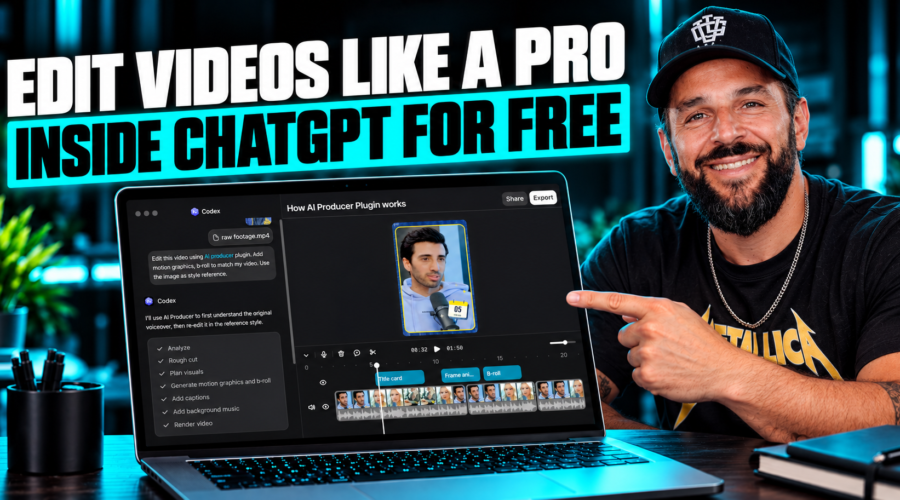
You can now shoot a raw video, upload it to ChatGPT, and get back an edited version with motion graphics, all without opening a traditional video editor.

Disclosure: this article includes a link to a tool we partner with. Availability, features and usage limits can change, so check your current plan before you start.

See it in action

Here is a quick look at the plugin at work before we get into the setup.

What is the AI Producer plugin?

AI Producer by OpusClip is a plugin you can add inside the ChatGPT app through Codex. Instead of learning timelines, keyframes and effects panels, you describe what you want in plain language and the plugin handles the editing work on your footage.

What can it do?

  • Add motion graphics to a raw video
  • Edit your footage in a polished, professional style
  • Match the style of another video you like

How to set it up, step by step

  1. Download the ChatGPT app and open it.
  2. Switch to Codex.
  3. Go to Plugins and search for AI Producer by OpusClip.
  4. Install the plugin.
  5. Shoot a raw video and upload it to ChatGPT.
  6. Ask it to add motion graphics, edit the video like a pro, or match the style of another video.
  7. Select the recommended model or a higher one, then let it work.
  8. Export, download and compare the result with your original footage.

Try AI Producer by OpusClip

Open the plugin page and see what it can do with your own footage.

Get the AI Producer plugin

Tips for better results

  • Start with clean footage, since good audio and lighting make any edit look better.
  • Be specific in your prompt about the style, pacing and type of graphics you want.
  • Use a reference video when you want a particular look, and ask the plugin to match it.
  • Review the export before publishing, and ask for another pass if something is off.

The bottom line

Video editing used to mean hours in a timeline. With a plugin like this inside an app you may already have, a first polished edit can take a single prompt. Try it on one short clip, compare it with your original, and decide whether it fits your workflow.

The Ultimate Tech & AI Career Toolkit: 30+ Best Websites for Jobs, Resumes & Skill Building

The Ultimate Tech & AI Career Toolkit: 30+ Best Websites for Jobs, Resumes & Skill Building

Looking for a tech job, or want to get paid while you learn AI? This is a curated list of more than 30 platforms for job hunting, resume building, technical practice, portfolio hosting, and AI training work.

If you work in tech, write code, or simply love AI, you already know the job search and upskilling process can feel broken. There are endless generic job boards, a portfolio to build from nothing, and interview loops that test skills you rarely use day to day. It is easy to get overwhelmed.

So we put everything in one place. The toolkit below is split into six pillars, and every tool links straight to its website. Bookmark this page, because you will want to come back to it.

Pillar 1Find Jobs: Where the Best Roles Are Hiding

Skip the outdated boards. Whether you want remote work, a fast-growing startup, or a big tech employer, these are strong places to start your search.

LinkedIn

The standard for professional networking, with direct recruiter outreach built in.

Indeed

A huge global volume of tech listings across every seniority level.

Wellfound

Formerly AngelList Talent, and a top destination for early-stage and high-growth startup roles.

Remote OK

A focused job board for remote software engineering, product, and design positions.

Y Combinator: Work at a Startup

A direct line to roles at startups backed by Y Combinator.

Pillar 2Practice Technical Skills: Ace the Hard Stuff

Before you can pass an interview, you need to be sharp on the fundamentals. These platforms help you build coding, SQL, and data skills with hands-on practice.

StrataScratch

Built for data scientists and analysts who want to practice real-world SQL and Python interview questions.

Codewars

Gamified coding challenges, called kata, that help you stay fluent in your favorite language.

Kaggle Learn

Free, bite-sized micro-courses covering machine learning, data science, and AI fundamentals.

SQLBolt

Interactive lessons and exercises that teach you SQL right in your browser.

Roadmap.sh

Community-built learning paths for web development, DevOps, AI engineering, and more.

Pillar 3Ace the Interviews: Mock and Master Your Loop

Technical interviews are a skill of their own. Practice algorithms, behavioral questions, and system design before the real thing.

LeetCode

The most popular place to practice data structures and algorithms problems.

HackerRank

Widely used by employers for technical screening and take-home assessments, so it is worth knowing the format.

Interviewing.io

Anonymous mock interviews with experienced engineers, including people from large tech companies.

Exponent

Courses and peer mock interviews for product management, software engineering, and other tech roles.

Glassdoor Interviews

Crowd-sourced interview questions and process write-ups from people who have interviewed at your target company.

Pillar 4Create a Killer Resume: Beat the ATS

Your resume gets you in the door. These tools help you pass applicant tracking systems and present your experience clearly.

Teal

An all-in-one career platform with a resume builder, job tracker, and keyword optimizer.

Novorésumé

Clean, ATS-friendly templates that make your career highlights easy to scan.

Kickresume

Modern templates paired with AI-assisted resume writing.

Resume.io

Quick-to-use templates with ready-made phrases you can tailor to your industry.

Canva Resume Builder

A good fit if you want a more visual, creative layout, especially for design, marketing, and creative tech roles.

Tip: very designed layouts can be harder for some applicant tracking systems to read. If you use a creative template, keep a plain version of your resume ready for online applications.

Pillar 5Build a Standout Portfolio: Show, Do Not Tell

In tech, projects often say more than credentials. Host your work somewhere recruiters and hiring managers can easily review it.

GitHub

The home for your code repositories, open-source contributions, and technical profile.

Kaggle

A leading community for data scientists to share datasets, notebooks, and competition results.

Hugging Face

A central hub for AI builders to share models, datasets, and interactive Spaces demos.

Devpost

A great place to showcase hackathon projects and collaborative builds.

Notion Portfolio Templates

A fast way to put together a clean, readable portfolio of case studies and writing.

Pillar 6Get Paid to Learn AI: Earn While You Upskill

AI companies regularly hire people to help train and evaluate language models, from writing prompts to reviewing code and checking outputs. It can be a practical way to build AI literacy while earning on the side.

Outlier AI

Flexible freelance work training language models, including writing prompts, reviewing code, and fact-checking AI responses.

CrowdGen

Appen’s global contributor platform for data annotation and AI training tasks.

Mercor

An AI-driven hiring platform that matches talent with AI training and engineering projects.

OneForma

Centific’s platform for translation, search engine evaluation, and AI data labeling projects.

TELUS International (Digital AI)

A large enterprise platform offering remote AI community work, data rating, and language tasks.

Worth knowing: availability, pay rates, and project volume on these platforms vary by country, skill set, and demand, and work is not guaranteed. Always read the terms, check how and when you are paid, and treat this as flexible side work rather than a guaranteed income source.

Final thoughtsPick Your Leverage

Landing a strong tech or AI role is less about working harder and more about using the right tools at the right time. You do not need all 30. Pick one platform from each pillar that fits your goals, whether that is sharpening SQL on StrataScratch, picking up AI training projects on Outlier, or tightening your resume with Teal, and start building momentum this week.

What is your go-to platform for the job search? Tell us in the comments below.

Want more practical AI tools and updates like this every week?

Join SimplyDigital

OpenClaw

Description

OpenClaw is an open-source AI-powered personal assistant designed to automate tasks across multiple platforms while interacting through familiar chat apps like WhatsApp and Telegram.

It functions like a digital teammate, capable of handling tasks such as email management, scheduling, reminders, and even travel-related actions.

With persistent memory, OpenClaw maintains context over time, enabling more natural and continuous interactions.

It prioritizes user privacy by keeping data and context stored locally on the user’s device. Built with adaptability in mind, OpenClaw can proactively execute tasks and evolve through community-driven improvements.

Use Cases

Personal Task Automation: Manage daily activities such as scheduling, reminders, and to-do lists.

Email Management: Organize, draft, and respond to emails efficiently.

Chat-Based AI Assistant: Interact with the assistant directly through platforms like WhatsApp and Telegram.

Travel Assistance: Handle tasks like flight check-ins and travel reminders.

Persistent Memory Context: Maintain long-term context for more personalized and relevant interactions.

Proactive Task Execution: Automatically perform background tasks and send timely reminders.

Team Collaboration Support: Act as a shared assistant for teams handling coordination and communication.

Privacy-Focused AI Usage: Keep user data stored locally for enhanced control and security.

Customizable Open-Source Assistant: Extend functionality through community contributions and custom setups.

Multi-Platform Integration: Connect with various tools and services for a unified workflow.

Z.ai

Description

Z.ai is an AI-powered chatbot assistant built on the GLM-4.6 model, designed to help users with a wide range of tasks including app development, presentation creation, and professional writing.

It provides intelligent, context-aware conversations that enable users to solve problems collaboratively and efficiently in real time.

The platform combines technical and creative capabilities, offering fast, reliable responses that adapt to user input and workflow needs.

Z.ai functions as a versatile assistant that supports both everyday productivity tasks and more complex work scenarios through natural language interaction.

Use Cases

App Development Assistance: Support coding, planning, and debugging through conversational AI guidance.

Presentation Creation: Generate structured and professional presentation content quickly.

Professional Writing: Assist with reports, emails, proposals, and other business documents.

Real-Time Problem Solving: Collaborate with AI to find solutions instantly through chat-based interaction.

Productivity Enhancement: Streamline daily workflows with fast, context-aware responses.

Creative Ideation: Generate ideas for projects, content, and business strategies.

Technical Support: Provide guidance on technical tasks and development processes.

Learning and Research: Help users understand complex topics through interactive explanations.

Workflow Automation Support: Assist in planning and structuring multi-step tasks.

Multifunctional AI Assistant: Adapt to different roles across professional and personal use cases.

LinkedIn Translate

Description

LinkedIn Translate is an AI-powered writing tool that transforms real-life career situations into polished, professional LinkedIn posts.

It takes awkward, sensitive, or challenging experiences and reframes them into optimistic narratives focused on growth, resilience, and career development.

The tool is designed to help users improve their professional online presence by converting informal or negative situations into structured, corporate-style storytelling suitable for networking platforms.

It supports a wide range of scenarios, from workplace mishaps to social or communication misunderstandings, and rewrites them into professional content.

Use Cases

LinkedIn Post Generation: Turn real-life career experiences into professional, engaging posts.

Personal Branding: Build a more polished and optimistic online professional identity.

Career Storytelling: Reframe challenges and setbacks into growth-focused narratives.

Workplace Communication Rewriting: Convert informal or awkward situations into corporate-friendly language.

Professional Networking Content: Create posts that are suitable for audience engagement on LinkedIn.

Tone Transformation: Shift casual or emotional language into structured, professional tone.

Resume and Profile Support: Help articulate experiences in a more impactful and professional way.

Reputation Management: Present career events in a positive and constructive manner.

Content Optimization: Improve clarity, tone, and readability of professional updates.

AI Writing Assistance: Generate ready-to-post LinkedIn content from raw personal input.

NemoClaw

Description

NemoClaw is an open-source AI agent infrastructure stack from NVIDIA designed to run always-on AI assistants in a secure, sandboxed environment.

It leverages the NVIDIA OpenShell runtime and Agent Toolkit to enable autonomous agents powered by models such as NVIDIA Nemotron, while enforcing strict security and execution policies.

The platform provides a containerized environment where AI agents operate under controlled conditions, including network restrictions, filesystem isolation, and governed inference routing.

Developers can deploy and manage agents via a CLI interface, connect to local or cloud-based model endpoints, and define versioned blueprints for reproducible agent behavior with strong security guarantees.

Use Cases

Secure AI Agent Deployment: Run always-on AI assistants in isolated, policy-controlled environments.

Autonomous Workflow Execution: Enable agents to perform tasks like automation, inference, and system interaction safely.

Model Routing Management: Direct inference to NVIDIA cloud APIs, local NIMs, or vLLM setups.

Secure Sandbox Execution: Prevent unauthorized access through filesystem and network isolation.

AI Development Testing: Build and test agent behaviors in controlled environments before production deployment.

CLI-Based Agent Control: Launch and manage AI agents using command-line tools.

Policy-Driven Security Enforcement: Apply declarative rules for system calls, network access, and execution limits.

Cloud and Local Hybrid AI: Seamlessly integrate local models with cloud inference pipelines.

Reproducible Agent Workflows: Use versioned blueprints to standardize agent behavior across environments.

Enterprise-Grade AI Safety: Ensure controlled execution of autonomous AI systems with layered security protections.

August AI

Description

August AI is a healthcare-focused artificial intelligence tool designed to help users understand medical information in a more accessible way.

It assists with interpreting lab reports, explaining symptoms, and providing context around medications and health-related queries.

The platform is positioned as a private and user-friendly assistant aimed at supporting health literacy and personal medical understanding.

It uses natural language processing to translate complex medical terminology into simpler explanations, helping users make sense of clinical data and general health concerns.

The system is designed for quick, on-demand support and is typically used as a supplementary informational resource rather than a replacement for professional medical advice.

Use Cases

Lab Report Interpretation: Helps users understand blood tests and medical results.

Symptom Explanation: Provides general insights into possible causes of symptoms.

Medication Information: Explains common uses, effects, and precautions of medicines.

Health Education: Breaks down complex medical terms into simple language.

Personal Health Awareness: Supports users in tracking and understanding health conditions.

Medical Study Support: Assists students in learning basic clinical concepts.

Patient Communication Aid: Helps users prepare questions for doctors.

General Wellness Guidance: Offers informational context for everyday health concerns.

TextaVoice

Description

TextaVoice is an AI text-to-speech tool converts written text into natural-sounding spoken audio and allows users to download the output as MP3 files.

It supports more than 30 languages and offers multiple voice options to generate lifelike narration that closely mimics human speech.

The platform includes advanced controls for adjusting speech speed, tone, and emotional expression, enabling users to tailor audio output to different contexts.

It also supports seamless multilingual pronunciation with accurate language switching, aiming to maintain natural articulation without noticeable accent distortion.

The tool is designed with privacy safeguards to ensure secure handling of user input and supports commercial usage of generated audio.

Use Cases

Voiceover Creation: Generate narration for videos, ads, and presentations.

Podcast Production: Create spoken audio content from written scripts.

Audiobook Generation: Convert written books into narrated audio format.

E-Learning Content: Add AI narration to educational materials and courses.

Corporate Training: Produce instructional audio for workplace learning.

Productivity Support: Listen to documents, notes, and reports hands-free.

Language Learning: Hear accurate pronunciation across multiple languages.

Accessibility Enhancement: Convert written content into audio for improved accessibility.

Content Repurposing: Transform blogs or articles into spoken media.

Multilingual Communication: Generate audio content across different languages.

Commercial Audio Production: Create usable audio assets for business projects.

Gridcast Sports Guide

Description

Gridcast Sports Guide is a sports viewing discovery platform that helps fans quickly find where to watch live games.

It centralizes information about television broadcasters, streaming services, and local venues, eliminating the need to search across multiple apps, TV guides, and websites.

The platform is designed to simplify last-minute viewing decisions by providing a single place to check game availability, identify the correct channel or streaming provider, and locate nearby sports bars showing the event.

Whether users plan to watch from home or in person at a venue, Gridcast Sports Guide offers a fast and convenient way to access live sports coverage.

Use Cases

Live Game Discovery: Find where a specific sporting event is being broadcast.

TV Channel Lookup: Identify the television network airing a game.

Streaming Service Finder: Discover which streaming platform carries a live match.

Sports Bar Locator: Find nearby venues showing a particular game.

Last-Minute Viewing Decisions: Quickly determine available viewing options before a game starts.

Centralized Sports Listings: Access broadcasters, streams, and venues from one interface.

Home Viewing Planning: Compare available channels and streaming services for watching at home.

Local Sports Viewing: Locate public venues broadcasting live sporting events nearby.

Multi-Sport Coverage: Track viewing information across different sports and leagues.

Fan Convenience: Reduce time spent searching across multiple sports and entertainment platforms.

CalcFi

Description

CalcFi’s Financial Calculators 2026 is a financial planning platform that provides access to more than 500 free calculators covering a wide range of personal finance and investment topics.

The platform is designed to help individuals and businesses quickly evaluate financial scenarios, compare options, and make more informed financial decisions without requiring account registration.

The calculators span key areas such as mortgages, retirement planning, taxes, debt management, savings, and investments.

By delivering instant results through a user-friendly interface, CalcFi enables users to perform financial analyses efficiently and explore different planning strategies with minimal effort.

Use Cases

Mortgage Planning: Calculate monthly payments, loan costs, and mortgage affordability.

Retirement Forecasting: Estimate retirement savings needs and future income requirements.

Investment Analysis: Evaluate returns, growth projections, and investment scenarios.

Debt Management: Calculate debt repayment schedules and interest costs.

Tax Estimation: Assess tax liabilities and compare tax-related scenarios.

Savings Goal Planning: Determine how much to save to reach specific financial objectives.

Loan Calculations: Analyze personal, auto, and business loan repayment terms.

Financial Decision Support: Compare multiple financial options before committing to major decisions.

Portfolio Planning: Model investment growth and long-term wealth accumulation strategies.

Business Finance Calculations: Perform financial assessments for business planning and budgeting.

Personal Budgeting: Understand spending, saving, and debt reduction strategies.

Quick Financial Analysis: Access instant calculations without registration or setup requirements.

Scroll to top